Appsentia's pattern detection engine automatically flags suspicious absence patterns that may indicate absenteeism abuse. Understanding these patterns helps you take informed action.
What Are Absence Patterns?
Absence patterns are specific behaviors in sick leave taking that statistically correlate with potential absenteeism abuse. These patterns don't prove wrongdoing, but they warrant closer attention and may indicate areas for investigation or policy enforcement.
The Five Key Patterns Detected
1. Weekend-Adjacent Sick Leave
What it is: Sick leave taken on a Friday or Monday, effectively extending a weekend.
Why it matters: Studies show employees take sick leave on Fridays and Mondays 40% more often than mid-week days, suggesting potential abuse rather than genuine illness.
Examples:
- Friday sick day = 3-day weekend
- Monday sick day = extended Sunday recovery
- Both Friday AND Monday = 4-day weekend
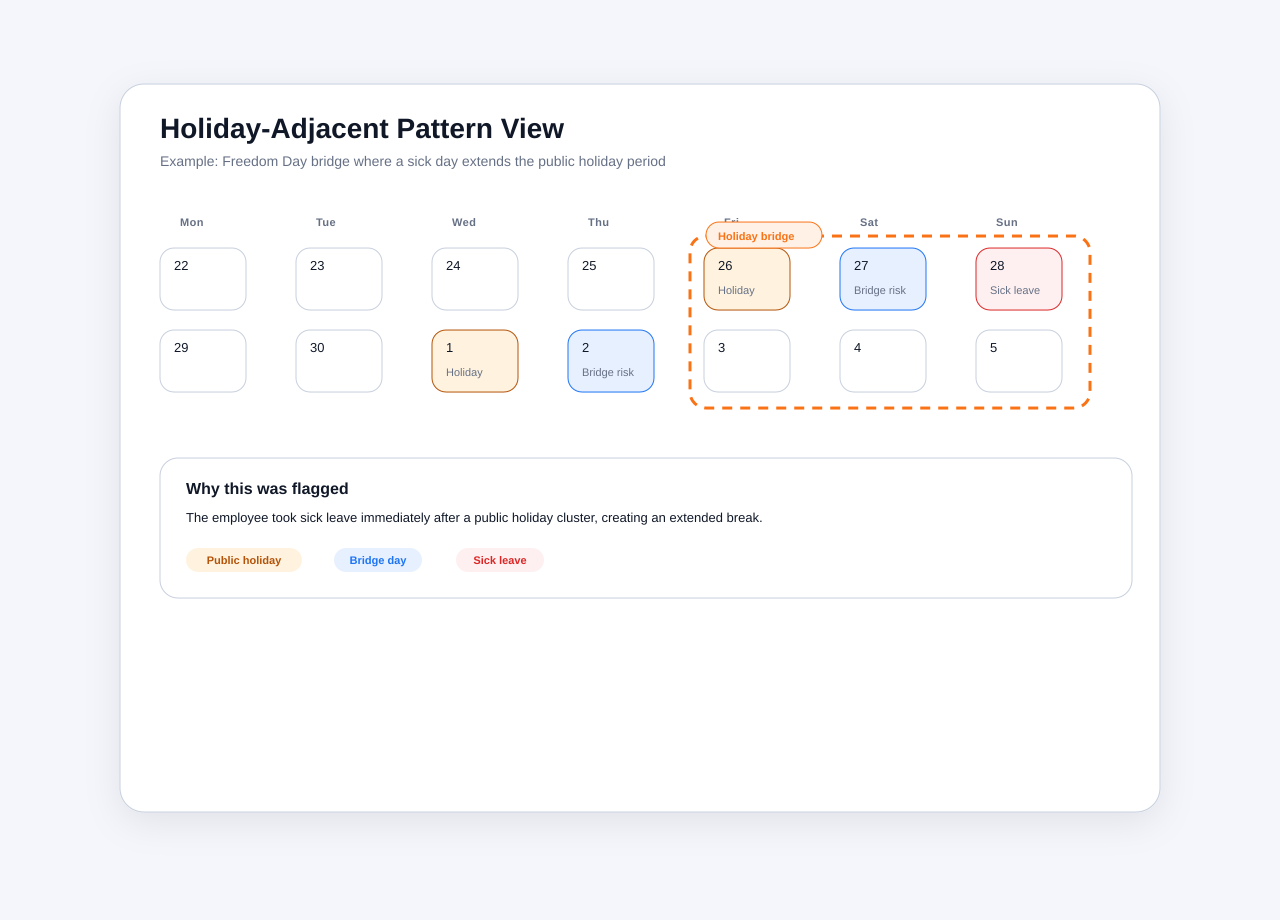
2. Public Holiday-Adjacent Sick Leave
What it is: Sick leave taken immediately before or after a public holiday.
Why it matters: Creating "bridge days" to extend holidays is a common form of absenteeism. For example, if a public holiday falls on Thursday, taking Friday sick creates a 4-day break.
High-risk periods in South Africa:
- Days around Easter weekend (March/April)
- Freedom Day (27 April) / Workers' Day (1 May) clusters
- Youth Day (16 June) bridges
- Heritage Day (24 September) extensions
- December holiday season (16 Dec - early January)
3. Payday or Following Day Sick Leave
What it is: Sick leave taken on payday or the immediate workday after.
Why it matters: This pattern often indicates "social Friday" behavior—employees receiving pay, then calling in sick the next day after celebrations or personal errands.
Common scenarios:
- Monthly payroll (25th/last Friday): Sick on Friday or following Monday
- Weekly payroll (Fridays): Sick on payday or following Monday
- Fortnightly payroll: Pattern every 2 weeks
4. Adjacent to Other Leave (Sandwich Leave)
What it is: Sick leave taken immediately before or after annual leave, family responsibility leave, or other approved leave types.
Why it matters: Employees may extend approved vacations by claiming sick leave before/after. This is especially common with annual leave during school holidays.
Examples:
- Annual leave: Dec 2-13, Sick leave: Dec 14-15 (extends holiday season)
- Family responsibility: Friday, Sick leave: Thursday (4-day weekend)
5. Short-Term Sick Leave (Under 5 Days)
What it is: Individual sick leave instances of less than 5 consecutive days.
Why it matters: Most companies don't require a medical certificate for absences under 3-5 days. This makes short sick leave easier to abuse. High frequency of short absences often indicates a pattern worth investigating.
Concerning patterns:
- 5 or more instances of 1-2 day sick leave in 6 months
- Repeated "Monday sickness" (always 1 day, always Monday)
- Sick leave every month without fail
Interpreting Pattern Flags on Reports
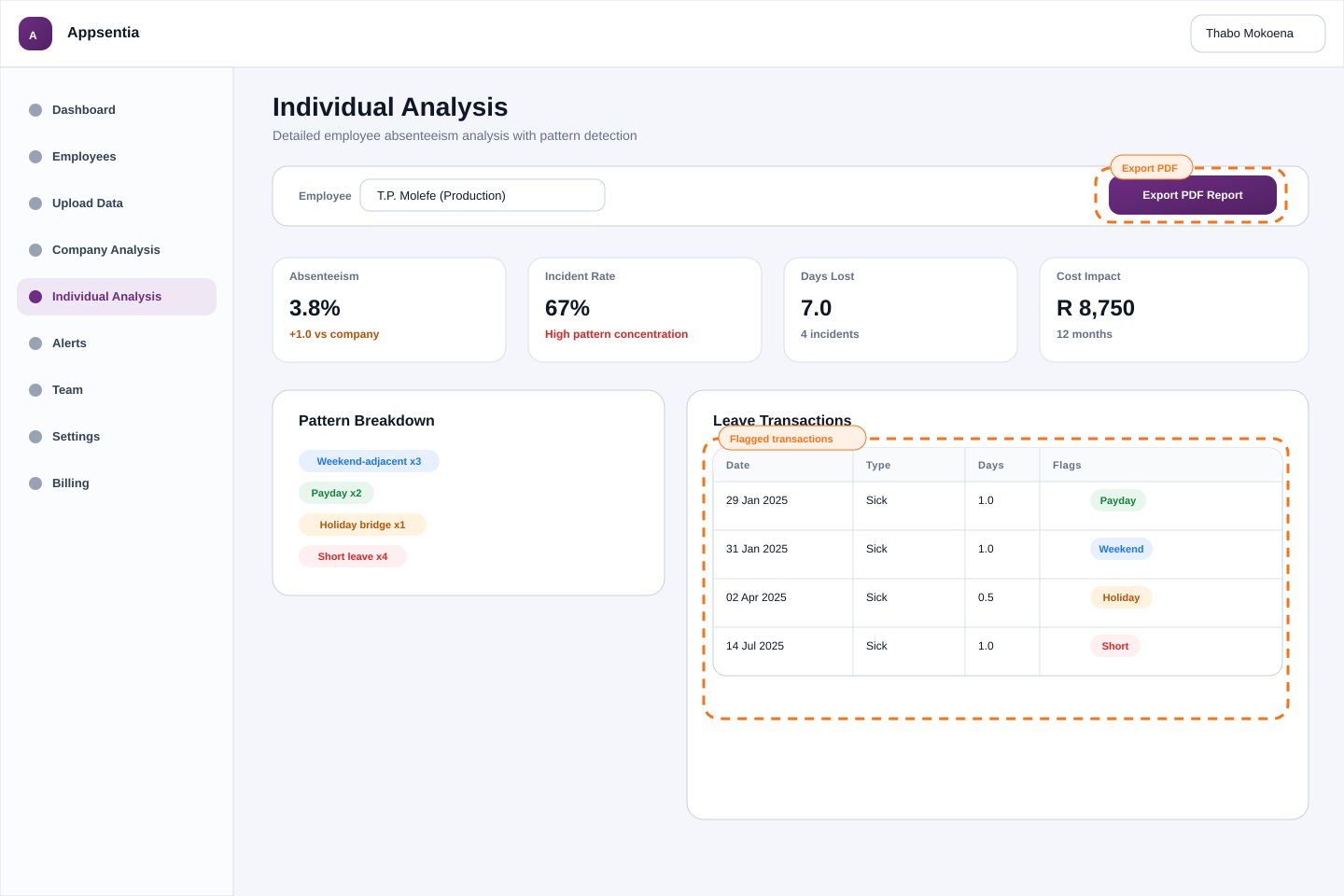
When reviewing Company Analysis or Individual Reports, you'll see pattern flags displayed in several ways:
1. Pattern Breakdown Cards
Each detected pattern appears as a metric:
- Number shows how many sick leave instances matched that pattern
- Hover/click for list of specific dates
- Compare across patterns to identify dominant behaviors
2. Leave Transaction Tables
In detailed views, flagged sick leave rows are highlighted with badge indicators:
- 🔵 Weekend: Weekend-adjacent
- 🟣 Holiday: Holiday-adjacent
- 🟢 Payday: On/after payday
- 🟡 Sandwich: Adjacent to other leave
- 🔴 Short: Under 5 days
A single sick leave instance can match multiple patterns (e.g., Friday before a Monday holiday = both weekend AND holiday-adjacent).
3. Risk Score (Professional/Enterprise)
Advanced plans include an AI-driven risk score (0-100) that combines:
- Incident rate weighting
- Frequency and recency of patterns
- Comparison to company baseline
- Historical trend (improving vs. worsening)
Taking Action on Pattern Insights
Step 1: Investigate Context
Before acting on flagged patterns, consider:
- Does the employee have a chronic health condition? (Legitimate high absence)
- Are there documented workplace issues (stress, harassment)?
- What does their manager report about performance and engagement?
- Are there other departments or teams with similar patterns? (May indicate broader issues)
Step 2: Conduct Informal Discussion
For moderate patterns (30-60% incident rate):
- Manager conducts a wellness check-in
- Express concern for employee's health without accusations
- Clarify company sick leave policy and medical certificate requirements
- Offer Employee Assistance Program (EAP) support if available
Step 3: Formal Performance Management
For severe patterns (over 60% incident rate, repeated after counseling):
- Document the pattern using Appsentia PDF reports
- Issue formal written warning outlining the concerns
- Require medical certificates for all future sick leave (regardless of duration)
- Set clear improvement expectations and review timeline
- Consider disciplinary action for continued abuse per your HR policy
Using Patterns for Policy Improvement
Company-wide pattern analysis can inform policy changes:
- High payday patterns? Consider changing pay frequency or implementing return-to-work interviews
- Frequent holiday bridges? Offer flexible leave policies so employees don't feel the need to abuse sick leave
- Department-specific patterns? Investigate workplace conditions, management issues, or understaffing
- Seasonal spikes? Plan for coverage during high-risk periods (e.g., December)
Limitations and Ethical Use
⚠️ Important Reminders
- → Patterns indicate potential issues, not proof of misconduct
- → Some employees legitimately get sick on Mondays or near holidays—investigate fairly
- → Consider broader workplace factors before blaming individuals
- → Use patterns as conversation starters, not evidence for immediate discipline
- → Respect employee privacy and dignity throughout the process
- → Comply with all applicable labor laws and collective bargaining agreements
Next Steps
Now that you understand pattern detection, learn how to:
- → Generate professional PDF Reports documenting these patterns
- → Implement Best Practices for reducing absenteeism in your organization
- → Use the Alerts feature to proactively monitor high-risk employees